
Raporty i bazy danych
Ponad 82 publikacji obejmujących bankowość, ubezpieczenia, płatności, kredyty hipoteczne i zarządzanie aktywami w Polsce i Europie Środkowo-Wschodniej.
Zdecydowana większość naszych raportów jest dostępna wyłącznie w języku angielskim. Tytuły, opisy i spisy treści poniżej pozostają w oryginale.
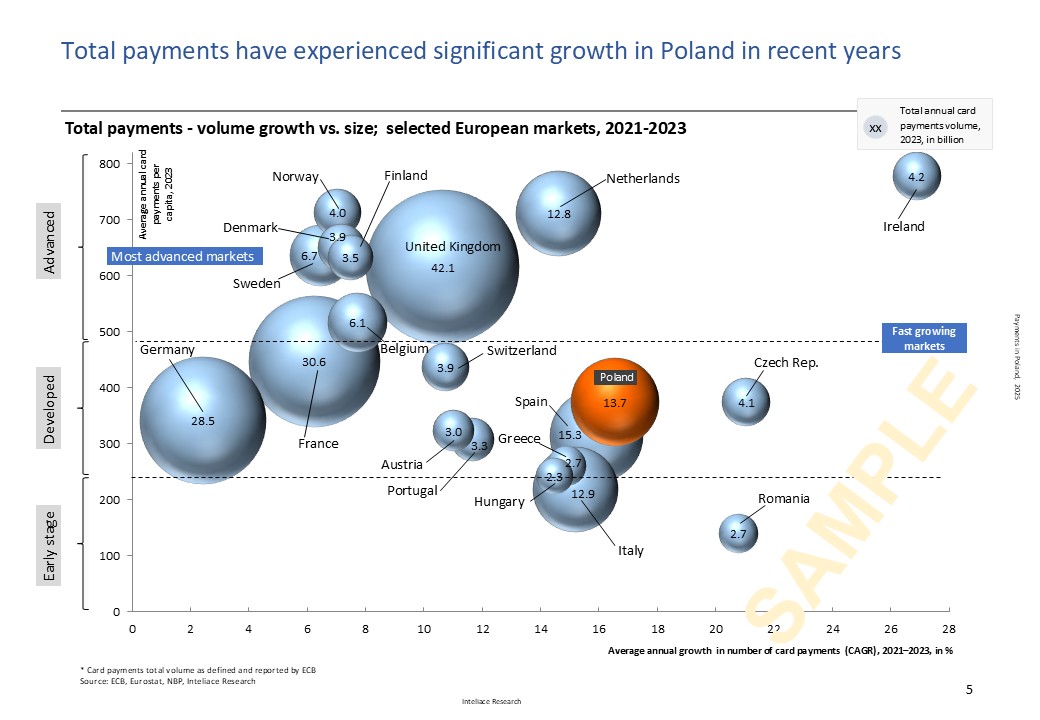
Payments in Poland, 2025
Poland's payment market continued its rapid expansion through 2024. The total number of payments in Poland exceeded 15.4 billion transactions, or approximately 420 transactions per capita, marking a robust 12% year-over-year growth. The largest portion of payment volumes—approximately 10 billion transactions—can be attributed to payment cards, which account for roughly 65% of all payments processed in the country. The remaining volume is almost evenly split between ACH credit transfers and BLIK, the leading domestic mobile payment system. In a broader European context, Poland ranks fifth in terms of payment volume, trailing only the UK, Germany, France, and Spain. Outlook The payments market is currently in a phase of rapid growth, and barring extraordinary events, this trajectory is expected to continue at least through 2026. As the Polish economy expands and eCommerce volumes are projected to grow further, the payments market is likely to sustain double-digit growth over the next two years. Key drivers will include the continued expansion of BLIK—which is expected to contribute the most—and payment cards, which, despite slower growth, will still account for a significant share of overall volume increases. Additionally, Express Elixir volumes, closely linked to BLIK, may experience a surge once payment deregulation progresses. However, there are a number of risk factors to consider moving forward, including regulatory issues. Although Poland is part of the Single Euro Payments Area (SEPA), it is not a Eurozone member. This status has allowed Poland to partially delay implementing extensive EU regulatory frameworks in the payments sector—historically benefiting local financial institutions but potentially dampening innovation. The significant upcoming changes affecting retail transactions and the shift towards real-time payments could have a substantial impact, although the outcome remains difficult to project. --------------------------------------------------------------------------------------------------------------------------------------
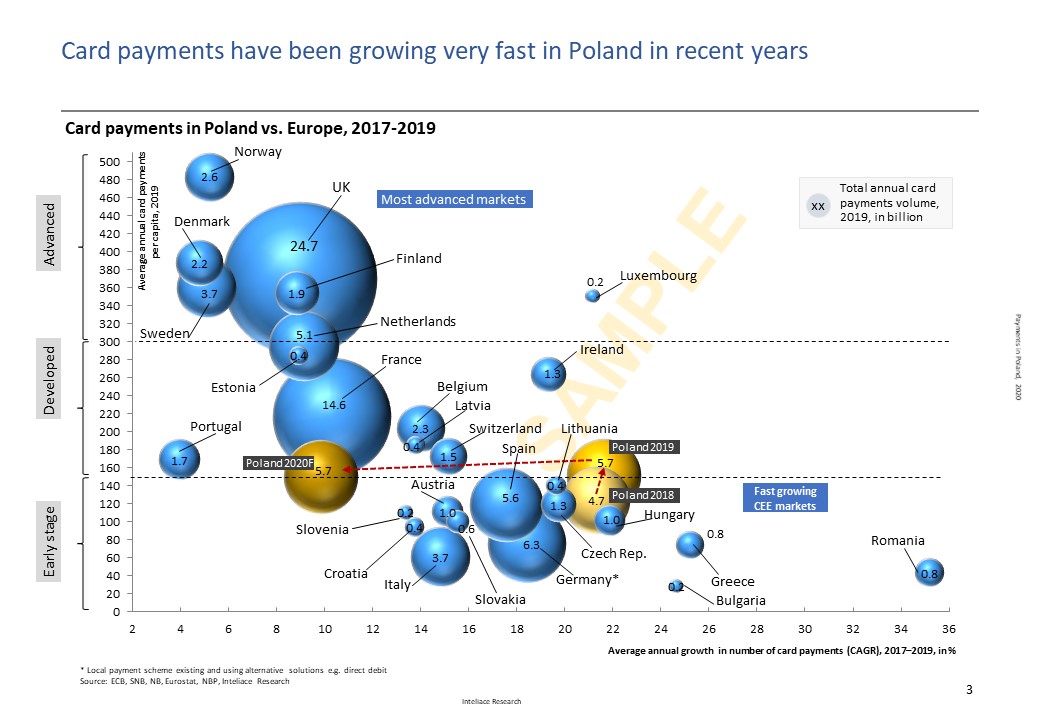
Payments in Poland, 2020
Poland's payment market had been growing fast until early 2020 when the trend came to an abrupt halt due to covid19 related business closures and highly reduced economic activity. While the total number of payments in Poland exceeded 8.8 billion in 2019, after increasing over 17% yoy, it is expected to stagnate and fall slightly in 2020. Outlook It can be expected that after the temporary stagnation in payment volumes, triggered by covid-19, the payment industry in Poland will gradually resume the growth. This will be, in particular, an effect of strong growth in eCommerce, replacing traditional, cash-intensive retail (B&M). Consequently, the very payment methods which are heavily used on the Internet are likely to benefit the most. --------------------------------------------------------------------------------------------------------------------------------------
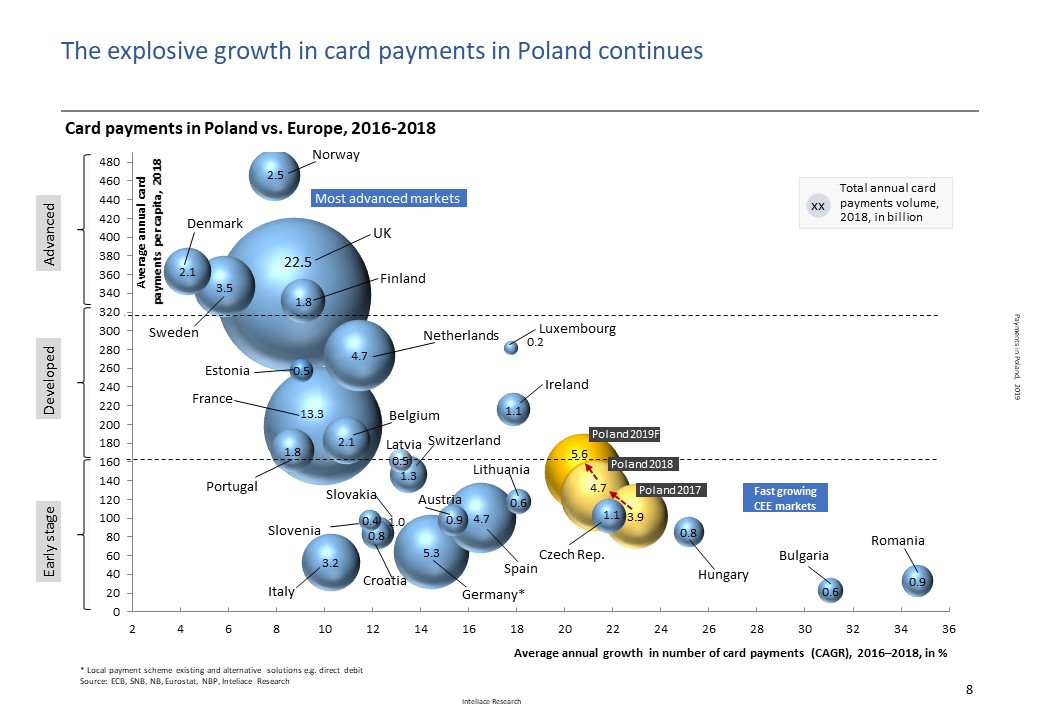
Payments in Poland, 2019
Poland's payment market continues to growth rapidly. The total number of payments exceeded 7.5 billion in 2018 and it remained on track to surpass 8.7 billion by 2019. Card payments alone reached nearly 4.7 billion transactions and they accounted for over 62% of all payments processed in the country. The persisting growth in card transactions can be attributed to fast expansion of the acceptance network and to increasing frequency in card use. In 2018, the average annual number of transactions per single card issued in Poland approached 114 tx. per card. Outlook The demand for convenient payment services and the ongoing support programs dedicated to the development of acceptance network, e.g. �Cashless Poland�, contribute to a gradual, although slow cash displacement. The current pace of growth in payment volumes is expected to remain strong, similarly to the dominating role of cards in overall payments. As a consequence, the total volume of payments in Poland is likely to reach 12 billion transactions by 2022. --------------------------------------------------------------------------------------------------------------------------------------
Payment apps and systems in Europe 2019, company profiles
Payments Payment / P2P apps and payment systemsUser engagement is highly correlated with adoption rates. So far, only three apps managed to break the vicious cycle of low adoption & low engagement - MobilePay (Denmark), Vipps (Norway) and Swish (Sweden). --------------------------------------------------------------------------------------------------------------------------------------
Payments in Poland, 2018
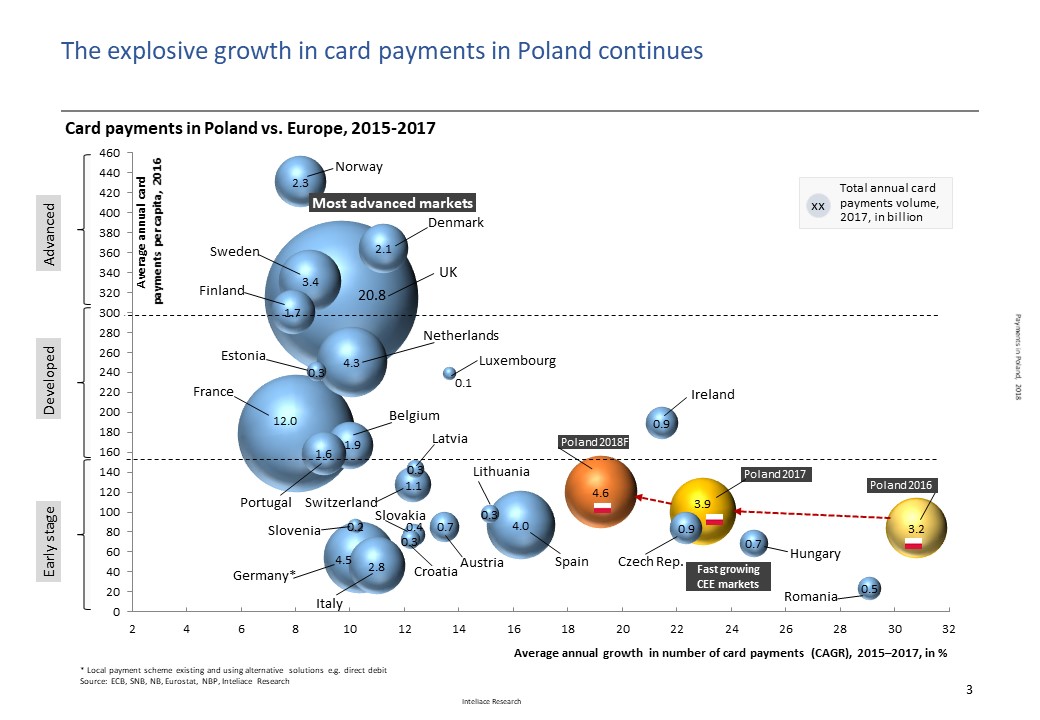
Poland's payment market has continued to experience explosive growth recently. The total number of payments exceeded 6.5 billion in 2017 and it remains on track to exceed 7.4 billion by 2018. Card payments alone reached nearly 3.9 billion tx level and they accounted for more than 59% of all payments processed in the country. The persisting growth in card transactions can be attributed to fast expansion of the acceptance network and to increasing frequency in card use. In 2017, the average annual number of transactions per single card issued in Poland approached 100 tx. per card and this ratio has more than doubled since the year 2014. Outlook The demand from consumers for convenient payment services and the ongoing support programs dedicated to the development of acceptance network, e.g. "Cashless Poland", contribute to a gradual, although slow cash displacement. It can be assumed that the growth in payment volumes will remain strong, similarly to the dominating role of cards in overall payments. The total volume of payments in Poland is likely to reach 11 billion transactions by 2022.
Payments in Poland, 2017
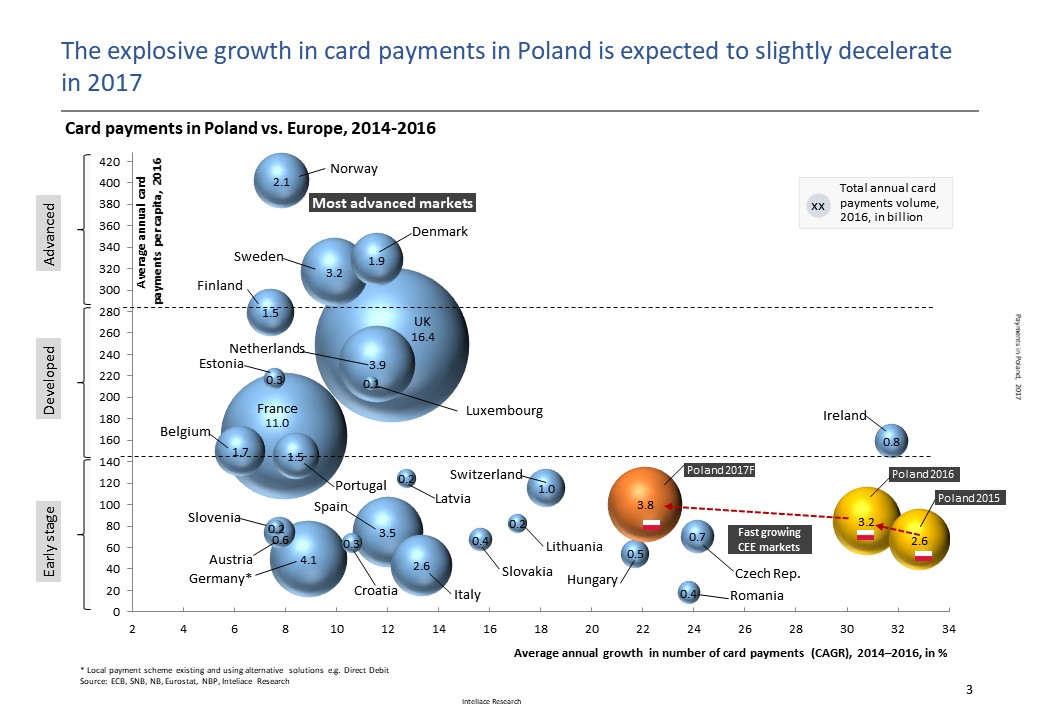
Poland's payment market is growing rapidly. The total number of payments exceeded 5.6 billion as of 2016 and it is estimated to top 6.4 billion in 2017. Most transactions executed in Poland involve payment cards and the share of cards in total payments exceeded 57%, corresponding to over 3.2 billion transactions in 2016. The fast growth in card transactions could be attributed to increasing frequency in card use and a gradual displacement of cash. Outlook The growth in payment volumes in Poland is likely to continue as will the role of cards in overall payments. Thanks to the proliferation of POS terminals and alternative payment solutions, in particular, in sectors where they have not been applied before, e.g. in public administration, the Post Office, local authorities and in smallest stores etc, cash will continue to be displaced. Assuming that no change in current trends will occur, the total volume of payments in Poland is likely to reach 10 billion transactions within next five years.
Payments in Poland, 2016
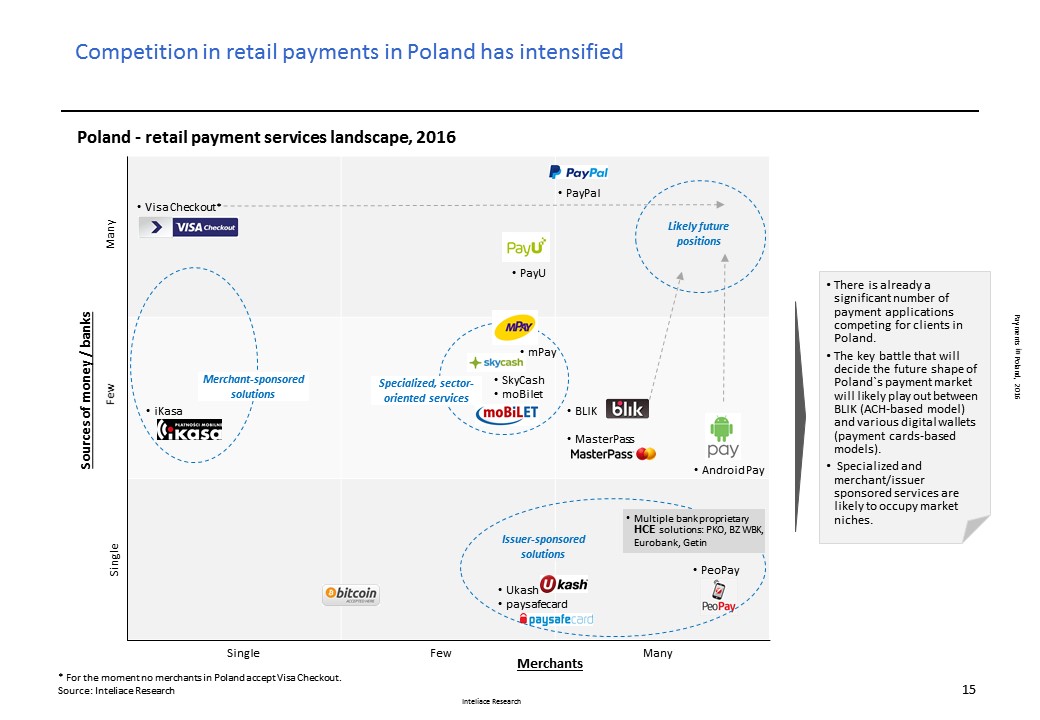
Poland's payment market has experienced an explosive growth during recent years. The number of card payments has more than doubled since 2013 and it has exceeded 3 billion by 2016. As consumers embraced card payments, Poland advanced to top six European markets by the number of transactions. The key factor of surging use of cards in Poland are contactless payments. Outlook The payment market will continue to expand in future as relatively high share of cash in Poland's economy offers a lot room for growth, in particular within: retail payments, P2P, public transport and public fees & duties. There is a clear opportunity in cash displacement and market participants are likely to address it. One can expect that over next five years a dominating mobile payment standard for mobile payments will evolve itself. It seems for the moment that the new standard will be based on payment cards rather than on ACH.