
Home › Reports › Top 200 banks
List of Top 200 banks in Central and Eastern Europe
List of Top 200 banks in Central and Eastern Europe (CEE15), edition 2016
About this report
Total banking assets in CEE15* exceeded 1.11 trillion EUR as of December 2015, after adding ca.3% value within a year. The profitability of major CEE banks has improved significantly with weighted ROA and ROE growing to 0.79% and 6.81% respectively in 2015. Despite recently observed convergence trends, there are still significant differences among CEE countries in terms of banking intermediation levels. While banking assets per capita exceeded EUR 20k in Slovenia, the benchmark was nearly 6 times lower for Albania and Bosnia-Herzegovina.The level of financial intermediation for most of CEE is still extremely low if compared to Western Europe and the gap is expected to narrow gradually. -------------------------------------------------------------------------------------------------------------------------------------- *CEE15 includes Poland, Czech Republic, Hungary, Slovak Republic, Romania, Bulgaria, Estonia, Latvia, Lithuania, Croatia, Slovenia, Serbia, Bosnia and Herzegovina, Albania, and Macedonia.
Table of contents
More on top 200 banks
See all →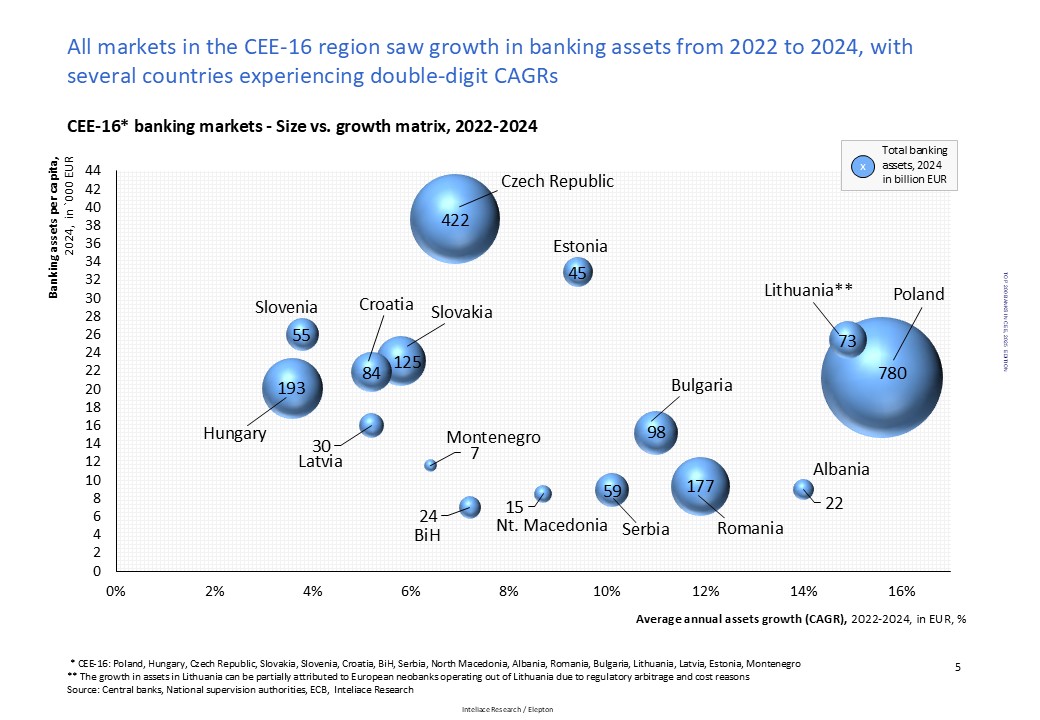
List of Top 200 banks in Central and Eastern Europe /2025 edition/
Total banking assets in the CEE16* region reached a record high of EUR 2.2 trillion by December 2024, reflecting an annual increase of 8.3%. This sustained expansion underscores the continued momentum of the Central and Eastern European banking sector, with nearly all 16 countries contributing positively to growth. Notably, Lithuania, Albania, and Poland stood out with annual growth rates exceeding 12%, highlighting the universal strength of the region’s financial ecosystem.
List of Top 200 banks in Central and Eastern Europe /2024 edition/
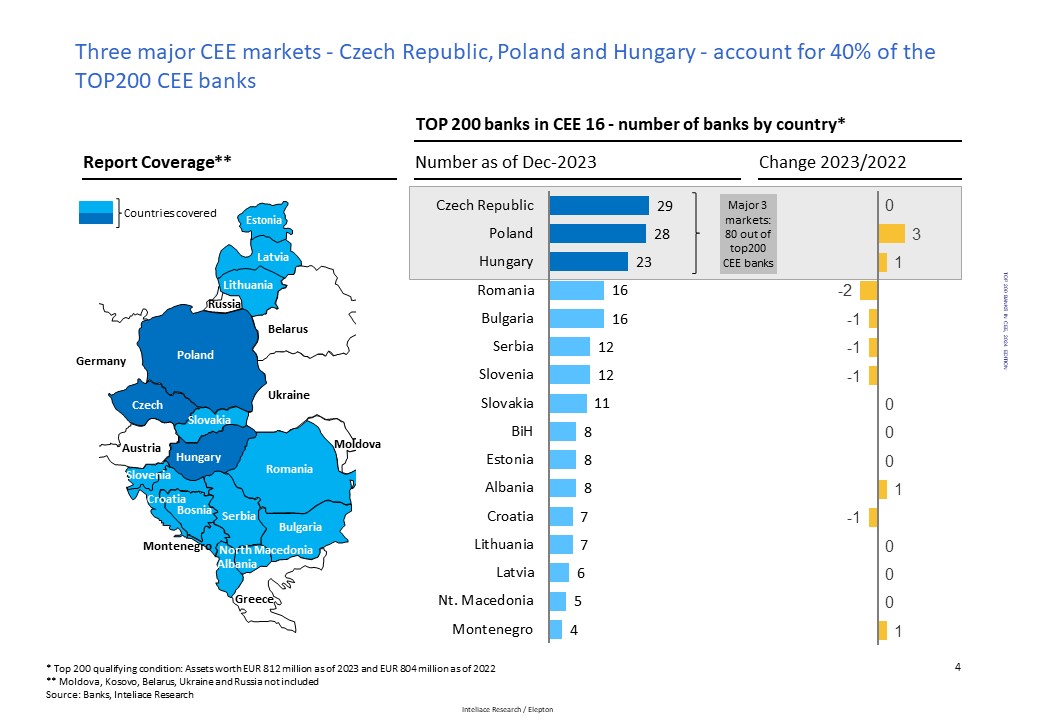
Total banking assets in CEE16* exceeded EUR 2.06 trillion as of December 2023 after growing by approximately 11.8% YoY. The year 2023 marked another robust performance for banks operating in Central and Eastern Europe (CEE16*), as the region experienced a significant asset growth of approximately 11.8% YoY, reaching a combined €2.06 trillion by December 2023 for the 16 countries in the region. The expansion in the CEE financial sector was evident in nearly all countries within the region, with some markets like Lithuania, Poland, and Hungary achieving double-digit growth rates. This recent surge in financial markets across CEE is a testament to the thriving economies, supported by healthy GDP growth and increasing individual incomes. Remembering the challenging year of 2020, when bank profits experienced a significant hit and key profitability benchmarks were more than halved, regional bankers have shown optimism with a gradual improvement in profitability since 2021. By 2023, the average Return on Assets (ROA) for the top 200 CEE banks reached 1.28%, while the average Return on Equity (ROE) was 11.5%. These figures represent a clear recovery and even surpass pre-pandemic levels, indicating a robust return to financial health. Moreover, the ongoing consolidation in the banking sector suggests a future dominated by a handful of top players who will effectively control the CEE markets. This trend towards consolidation around leading groups like Erste, KBC, PKO Bank, OTP, UniCredit, and Raiffeisen is likely to enhance market stability and drive further growth. For more information about developments in the banking sectors in CEE, please review the full publication. ------------------------------------------------------------------ *CEE16 include: Poland, Czech Republic, Hungary, Slovak Republic, Romania, Bulgaria, Estonia, Latvia, Lithuania, Croatia, Slovenia, Serbia, Bosnia and Herzegovina, Albania, Montenegro and North Macedonia.
List of Top 200 banks in Central and Eastern Europe /2023 edition/
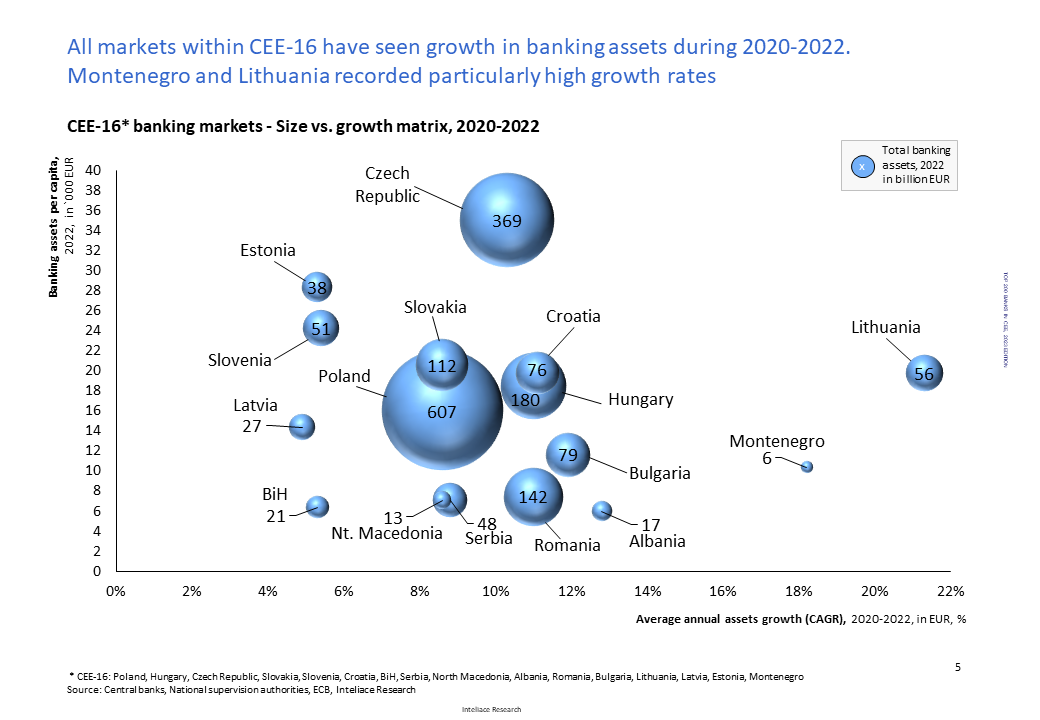
Total banking assets in CEE16* exceeded EUR 1.84 trillion as of December 2022 after growing by over 8% YoY. The year 2022 marked a robust performance for banks operating in Central and Eastern Europe (CEE16*), as the region experienced a remarkable asset growth of over 8% YoY, reaching a combined €1.84 trillion by December 2022, for 16 countries in the region. The expansion in the CEE financial sector was evident in nearly all countries within the region, with some markets like Croatia, Bulgaria, Romania, Albania, and Montenegro achieving double-digit growth rates. This recent surge in financial markets across CEE is a testament to the thriving economies, supported by healthy GDP growth and increasing individual incomes. Remembering the challenging year of 2020, when bank profits experienced a significant hit and key profitability benchmarks were more than halved, regional bankers have shown optimism with a gradual improvement in profitability since 2021. By 2022, the average Return on Assets (ROA) for the top 200 CEE banks reached 0.92%, while the average Return on Equity (ROE) was 9.9%. Although these figures are still below the levels recorded in the years 2016-2019, there is an expectation that regional banks will manage to return to their historical performance. For more info about developments in banking sectors in CEE please review the full publication. ------------------------------------------------------------------ *CEE16 include: Poland, Czech Republic, Hungary, Slovak Republic, Romania, Bulgaria, Estonia, Latvia, Lithuania, Croatia, Slovenia, Serbia, Bosnia and Herzegovina, Albania, Montenegro and North Macedonia.