
About this report
Total banking assets in Romania increased by 4.4% YoY to a record of RON 394 billion as of December 2016. Client deposits at banks recorded strong 12% YoY growth to nearly RON 333 billion with government and household deposits increasing most quickly. By contrast, outstanding client loans increased only by a fraction in 2016 and reached RON 231 billion. This was a consequence of a continued contraction in corporate lending and a still slow growth in retail loans. One of the most encouraging trends has been the falling ratio of non-performing loans which has halved since 2014. Banking sector in Romania has also made a significant progress in reducing currency risk as the share of outstanding loans denominated in foreign currency has fallen substantially, in particular in case of corporate and mortgage loans. For more information on recent developments in the banking sector in Romania, please refer to the full publication.
Table of contents
More on banking
See all →
Project Orzeł: Strategic Assessment of a Potential Combination of PKO Bank Polski and Bank Pekao
A combination of PKO Bank Polski and Bank Pekao would create a bank of approximately PLN 976 billion in assets and EUR 217 billion of CEE-controlled banking assets — second only to Erste Group across the entire CEE-16 region, and ahead of UniCredit even after its pending acquisition of Commerzbank brings mBank under its ownership. The case for it is scale: Erste has just acquired a top-five Polish bank worth more than Pekao, and UniCredit's return to the market via mBank restores a Polish franchise of real substance to a second pan-European group. PKO and Pekao, meanwhile, compete against each other in 355 of the 727 localities where either operates — a structural gift to both foreign consolidators.
Banking Market in Poland, 2023-2025
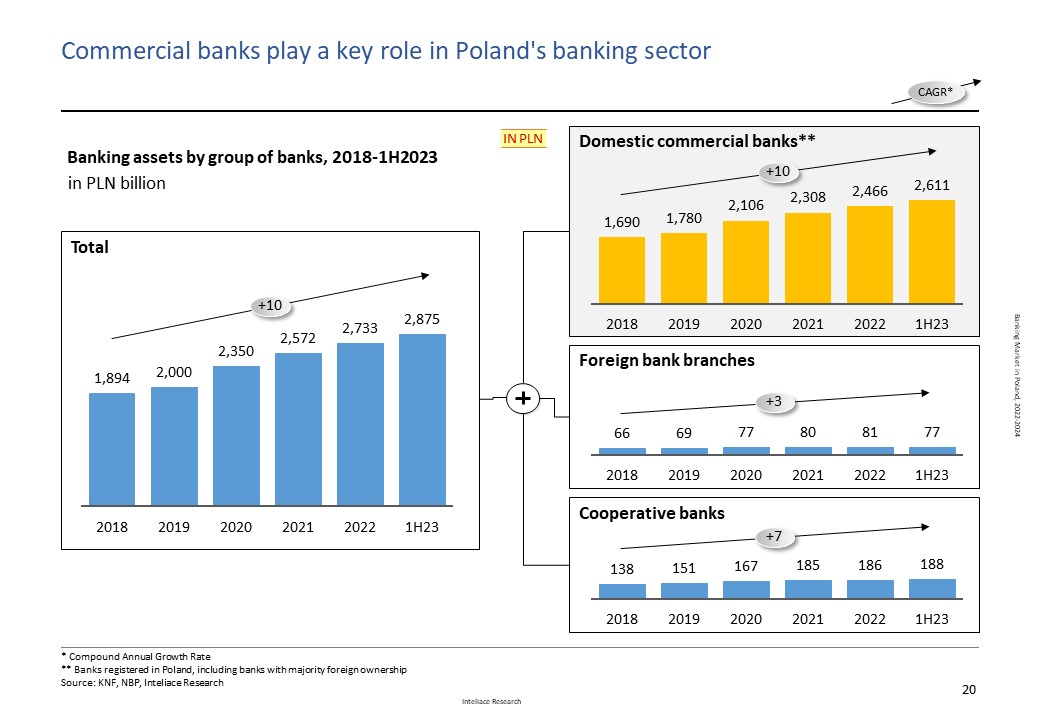
The competitive landscape within the Polish banking sector has not changed much over the past few years. The group of major commercial banks remained unchanged, concurrently increasing its market share slightly, indicating a trend toward growing concentration. Noteworthy in this context is the government-owned SPV Bank - BGK, which has ascended the top list of banks due to its exclusive rights in distributing support and lending funds from both the government and the EU. While there has been little M&A activity in the banking sector recently, an exception from this trend is Velo Bank. This institution is currently available for acquisition following a compelled restructuring and takeover by the government of the erstwhile Getin Noble Bank. The sales tender is presently open, with expectations for closure early in 2024. The surge in market interest rates, rising from zero to approximately 6.5% in 2022, had a profound impact on the banking sector. The escalating cost of money significantly influenced the new investment demand of corporations, while simultaneously limiting the capacity of individuals to secure new loans. Conversely, the notably higher interest rates, though still below inflation, spurred interest in depositing funds in banks. Consequently, overall client deposits at banks reached PLN 1.92 trillion in Q2 2023, reflecting an 11%+ change over 1½ years since the end of 2021. Concurrently, client loans experienced a contraction of over 2%, decreasing from PLN 1.29 trillion at the close of 2021 to PLN 1.26 trillion in Q2 2023. Despite many challenges, the future outlook for key banking volumes remains favorable. Total banking assets are projected to grow steadily, potentially reaching PLN 3.5 trillion by the end of 2025. For more information on recent developments in the Polish banking sector, please refer to the full publication.
Banking Market in Poland, 2020-2022
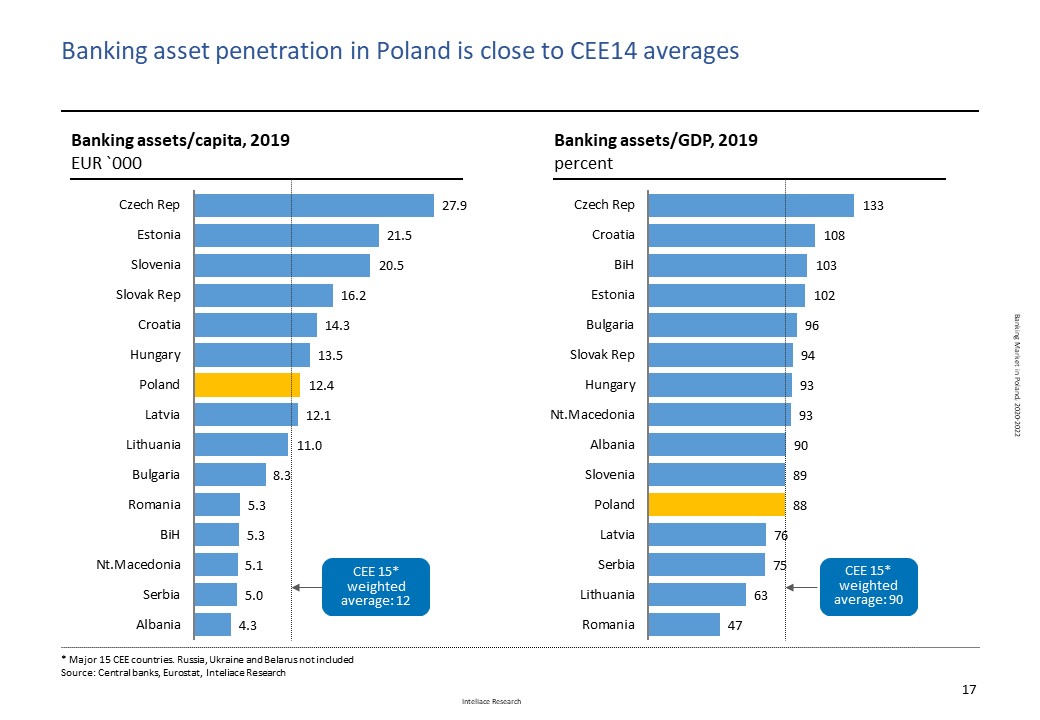
Banking volumes have continued to grow steadily during 2019 and Q1 2020. Deposits of non-financial clients at banks reached PLN 1.43 trillion after a 5% jump in Q1 2020 while client loans increased to PLN 1.26 trillion in Q1 2020, recording a 4% QoQ growth. The recent change in key volumes was balanced across all client segments. However, faster growth in deposits than in loans resulted in increasing liquidity within the sector. Total banking assets followed positive trends in client segments and they exceeded PLN 2.1 trillion as of March 2020. In terms of profitability, banks operating in Poland recorded a 9% jump in bottom line to PLN 14.2 billion in 2019 or a 9% YoY growth. The ROAA* and ROAE* benchmarks improved by a fraction to 0.73% and 6.88% respectively, in 2019. Nevertheless, this highly favourable outlook has been reversed in Q1 2020 when the Monetary Policy Council (RPP) started a new easing cycle. The dramatic shift in monetary policy in Q1 2020 combined with a weakening economy has created significant challenges to all banks operating in Poland. The series of interest rate cuts of 140 bp in Mar.-May 2020 alone is estimated to wipe ca. 33% of bank profits in 2020. Moreover, the predicted growth in regulatory charges, taxes and increased credit risk, will further cut into earnings. As a consequence, the bottom line of banks is likely to drop by over 50% in 2020 vs. the year before. This will be a major shock for banks as the over decade long period of stable profits has come to an end. Consequently missing profits will create a growth barrier for banks with thin equity buffers. For more information on recent developments in the Polish banking sector, please refer to the full publication.