
Home › Reports › Mortgage lending
Mortgage lending in Poland, 2021-2023
Research report: Mortgage lending in Poland, 2021
About this report
The residential construction in Poland remained hot in 2020 with home completions increasing by over 7% YoY and reaching a multi-year high at 222k. Nevertheless, there have been also first signs of stabilization with permits growing just by fraction and home starts falling slightly vs. 2019. At the same time, real estate prices continued to climb very fast, fuelled by more and more negative real interest rates and by accelerating CPI, which surpassed 4% in March 2021. By contrast to real estate prices, mortgage lending cooled down slightly with new sales of mortgage loans decreasing by 10% and 3% YoY in terms of volume and value respectively in 2020. Slower sales of new mortgage on the growing real estate market could be attributed mostly to the impact of COVID-19 with lockdowns and stricter lending rules at banks. Nevertheless, mortgage lending is expected to rebound fast once the pandemics eases and it might hit new records already in 2021. For more information on recent developments in the Polish banking sector, please refer to the full publication.
Table of contents
More on mortgage lending
See all →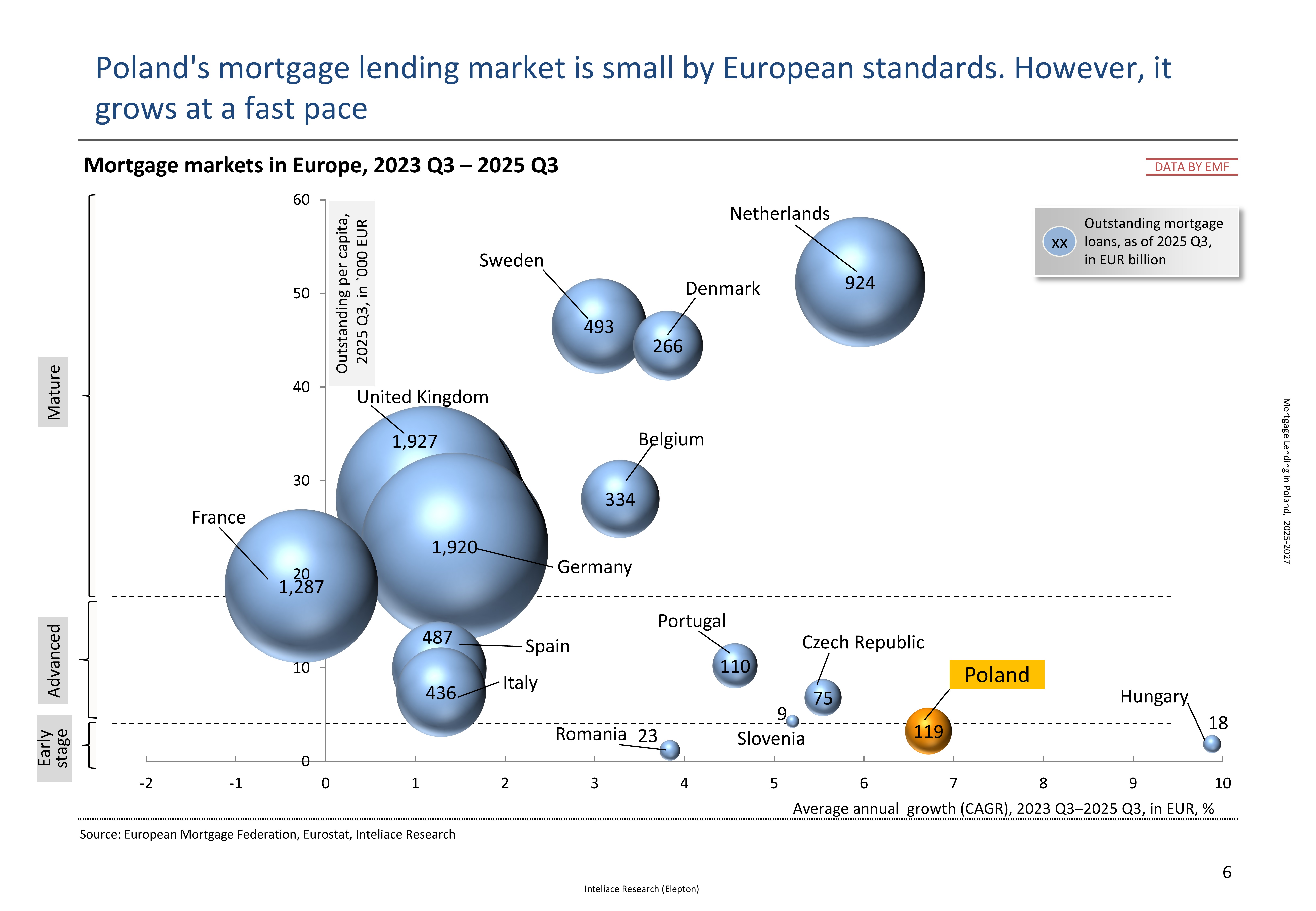
Mortgage lending in Poland, 2026-2028
The housing sector exhibited stabilization throughout 2025. Building permits and housing starts declined slightly, while completions continued to increase modestly, reflecting a balanced market adjustment. Residential real estate prices have consolidated since 2024, stabilizing at current levels without significant upward or downward pressure. This price stabilization, combined with the absence of government subsidy programs, has encouraged a more measured approach among developers and buyers alike. The market appears to have reached an equilibrium where supply and demand dynamics support sustainable activity levels without excessive price volatility. Mortgage lending activity strengthened considerably in Poland in 2025, with new mortgage originations exceeding PLN 103 billion and demonstrating double-digit growth in both value and volume. Despite this robust expansion, the number of active mortgage contracts continues to decline, currently standing at 2.15 million. This contraction reflects ongoing refinancing activity and the systematic closure of legacy foreign-exchange-denominated loans, which have been a persistent challenge for borrowers and lenders alike. The resilience in new lending reflects improved borrower affordability, driven by robust wage growth and tightening labor market conditions. Poland's mortgage market is positioned for moderate growth through 2028, supported by improving affordability dynamics. Wages are expected to continue rising while residential property prices consolidate, collectively enhancing household purchasing power and lending capacity. In a baseline scenario, outstanding mortgage balances are projected to reach PLN 627 billion by 2028, corresponding to approximately 14% of GDP. This represents accelerated growth of 8% year-over-year, compared to the 5% annual growth observed between 2023 and 2025. However, a significant downside risk exists from potential interest rate increases driven by accelerating global inflation and elevated energy prices. Any such monetary tightening could materially constrain borrowing affordability and dampen the projected expansion of mortgage lending activity. For more information on recent developments in the Polish banking sector, please refer to the full publication.
Mortgage lending in Poland, 2025-2027
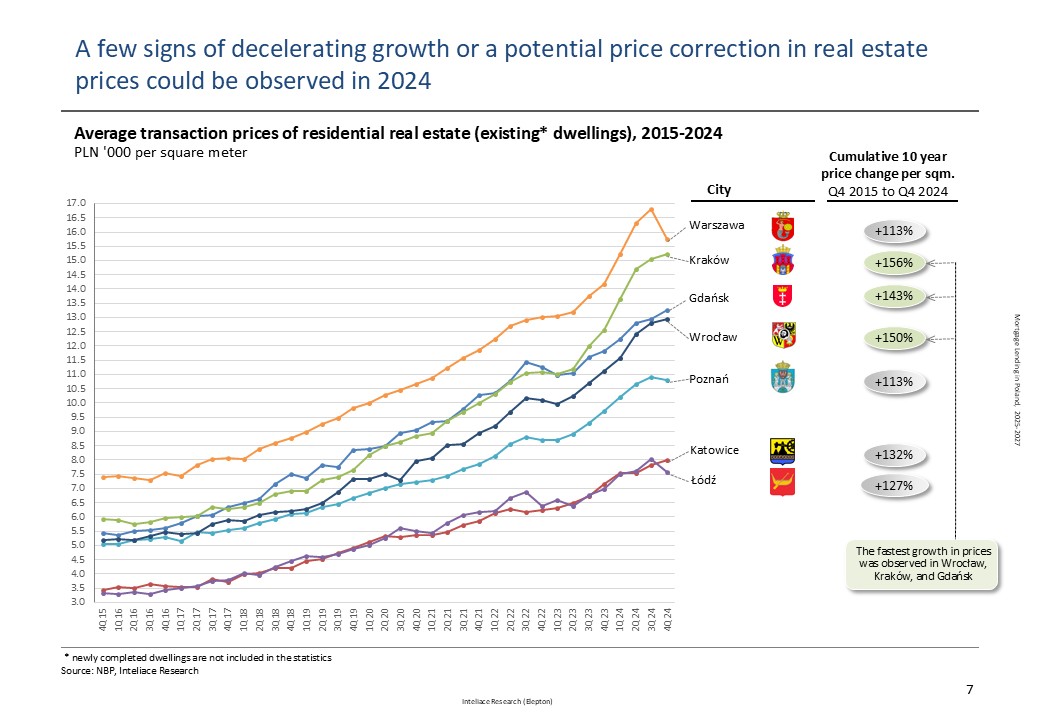
The housing sector reflected divergent trends in 2024. While building permits and housing starts recovered, completions declined to 200,000 units (down from 221,000 in 2023). This contraction can be linked to persistently elevated real estate prices and the discontinuation of government subsidy programs. Developers have adopted a cautious approach by delaying sales amid softening demand at current price levels, potentially anticipating renewed first-time buyer incentives. Notably, the absence of such subsidies in 2024 contributed to moderating property price inflation, though future policy support remains uncertain. Poland’s mortgage market is poised for steady growth through 2027, supported by sustained economic momentum and improving housing affordability. Despite the lack of confirmed government interventions for first-time buyers, moderating property prices and rising disposable incomes are expected to sustain lending volumes. Under a baseline scenario (assuming no major policy shifts), outstanding mortgage balances are projected to reach PLN 647 billion by 2027, with the mortgage-to-GDP ratio recovering from 13% to 15%. A critical risk to this outlook remains the trajectory of interest rates. The Monetary Policy Council (RPP) faces mounting pressure to sustain a restrictive monetary policy to offset expansionary fiscal measures. Any recalibration of rates—whether upward or downward—would materially influence borrowing costs, affordability, and ultimately, lending activity. For more information on recent developments in the Polish banking sector, please refer to the full publication.
Mortgage lending in Poland, 2024-2026
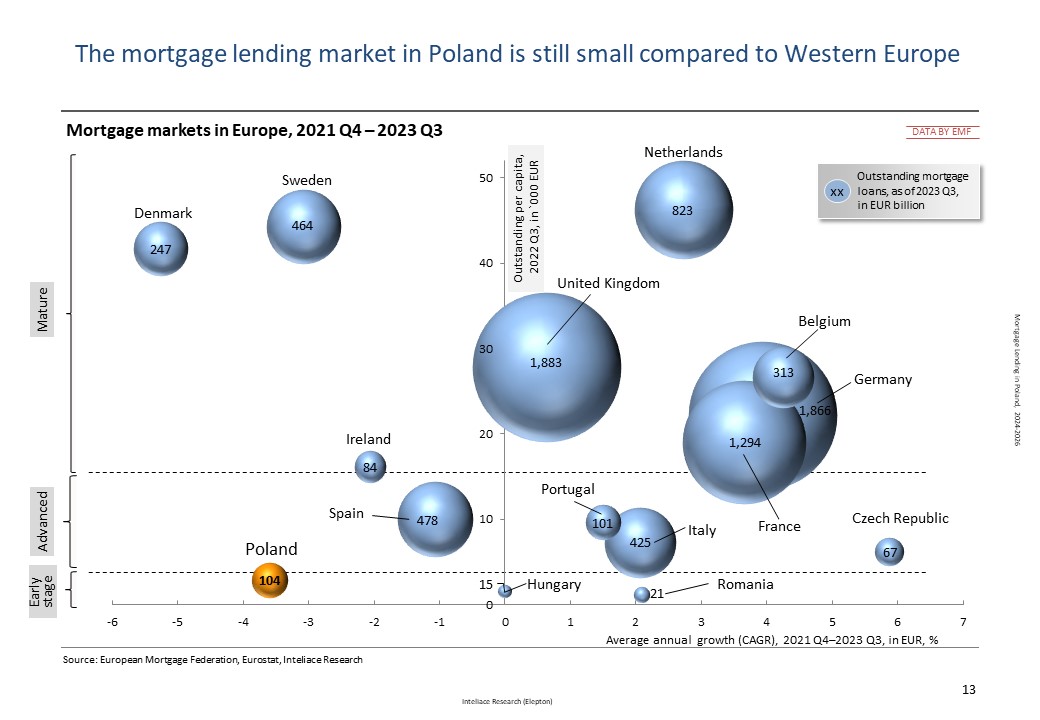
The residential construction industry in Poland continued to be impacted by negative trends that began in 2022. Declines in building starts (-9% YoY), permits (-19% YoY), and completions (-8% YoY) were recorded in 2023. This reduced supply of new real estate, combined with demand stimulation resulting from a new government-sponsored program dedicated to first-time homebuyers, was reflected in accelerating real estate prices. As the prices of real estate break all-time records, the affordability for buyers keeps falling, which is a key factor supporting the growth in new mortgage lending. The recent downturn in real estate construction, seen in 2022 and 2023, is expected to reverse due to rising property prices and new governmental support programs that are anticipated to boost demand. The impact of the monetary factor—namely high interest rates—is projected to diminish in 2024 and 2025, which should further support growth in new mortgage lending. This sector is poised for additional momentum from a new government lending support scheme planned for 2024. Assuming these conditions, our base scenario forecasts a slight increase in overall mortgage lending in 2024, followed by a more significant rise in 2025 and 2026. Total outstanding lending is estimated to reach PLN 545 billion by 2026, with the loan-to-GDP ratio expected to stabilize at approximately 13%. For more information on recent developments in the Polish banking sector, please refer to the full publication.