
Research reports & databases
82 publications covering banking, insurance, payments, mortgage lending and asset management across Poland and Central & Eastern Europe.
Payments in Poland, 2018
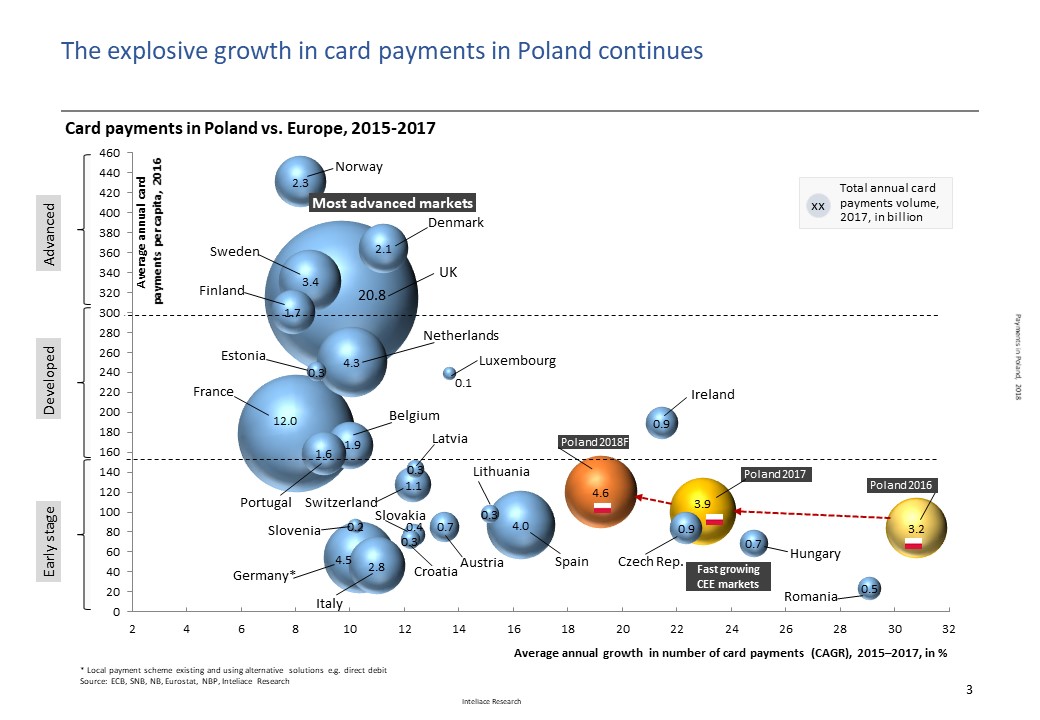
Poland's payment market has continued to experience explosive growth recently. The total number of payments exceeded 6.5 billion in 2017 and it remains on track to exceed 7.4 billion by 2018. Card payments alone reached nearly 3.9 billion tx level and they accounted for more than 59% of all payments processed in the country. The persisting growth in card transactions can be attributed to fast expansion of the acceptance network and to increasing frequency in card use. In 2017, the average annual number of transactions per single card issued in Poland approached 100 tx. per card and this ratio has more than doubled since the year 2014. Outlook The demand from consumers for convenient payment services and the ongoing support programs dedicated to the development of acceptance network, e.g. "Cashless Poland", contribute to a gradual, although slow cash displacement. It can be assumed that the growth in payment volumes will remain strong, similarly to the dominating role of cards in overall payments. The total volume of payments in Poland is likely to reach 11 billion transactions by 2022.
Investment funds and asset management market in Poland, 2018
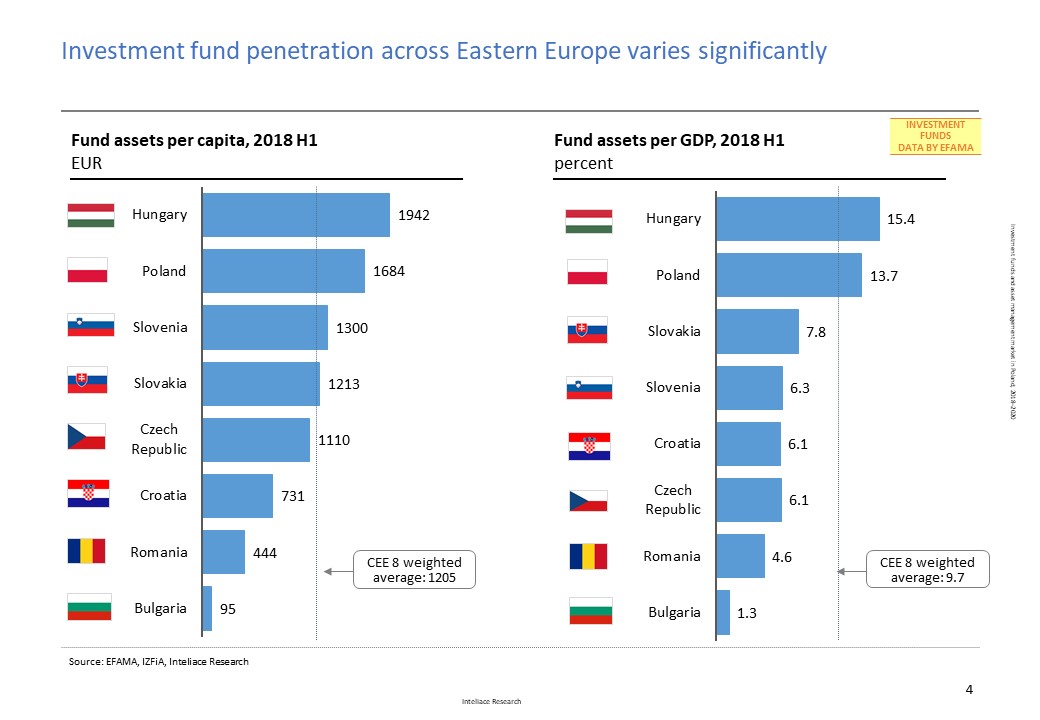
After the period of a very fast growth during 2016-2017, total* assets under management in Poland decreased slightly in H1 2018 to PLN 627 billion. This was largely an effect of weaker performance of the local stock market in the first half of 2018 which translated into lower valuations of equity portfolios. The recent correction affected mostly 2nd pillar pension funds, which by law have to overweight equities. Other segments remained relatively stable thanks to new contributions offsetting weaker performance. As of June 2018, assets of regulated investment funds** reached PLN 297 billion, 3rd pillar pension assets exceeded PLN 23 billion and reserves of insurance companies stagnated at PLN 149*** billion. The asset management market remained medium-concentrated with top four groups: PZU, Aviva, NN and Ipopema managing roughly half of all assets in the market Outlook Assets under management in Poland are expected to sustain a solid growth through 2020. The most action is likely to take place within 3rd pillar pension funds since the new legal framework will mandate employers to enrol all employees and to finance contributions to employee plans. Also insurance assets and investment funds are likely to grow thanks to key driving forces: increasing wealth of individuals and low interest rates at banks.
Banking market in Romania, 2018
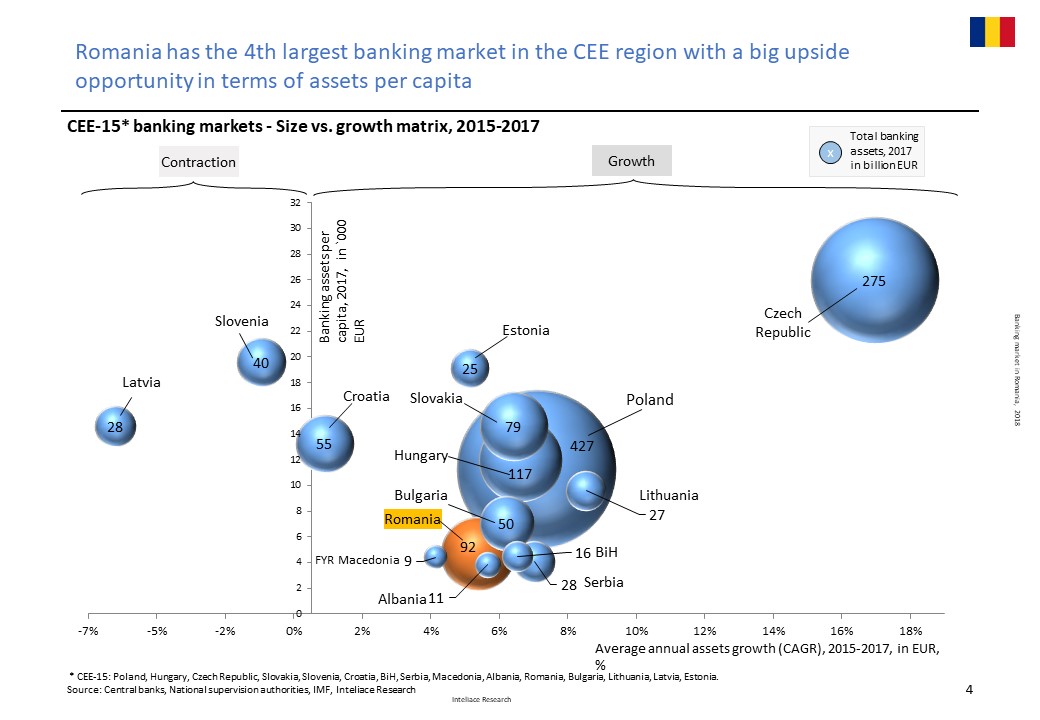
Total banking assets in Romania increased by 9% YoY in 2017 and they also sustained fast growth in the first three quarters of 2018, hitting a record high of RON 445 billion as of September 2018. Client deposits at banks recorded slightly slower rate of growth to nearly RON 368 billion with household deposits remaining strong. By contrast, outstanding client loans grew faster than in the past and reached RON 257 billion as of Q3 2018. The faster pace of growth in outstanding loans has been accompanied by the falling ratio of non-performing loans. The NPL ratio has more than halved since 2016 and reached 5.7% (EBA ratio) as of June 2018. The sector has also made further progress in containing currency related risks as the share of outstanding loans denominated in foreign currency has been reduced substantially, in particular, in case of mortgage loans. For more information on recent developments in the banking sector in Romania, please refer to the full publication.
List of Top 200 banks in Central and Eastern Europe /2018 edition/
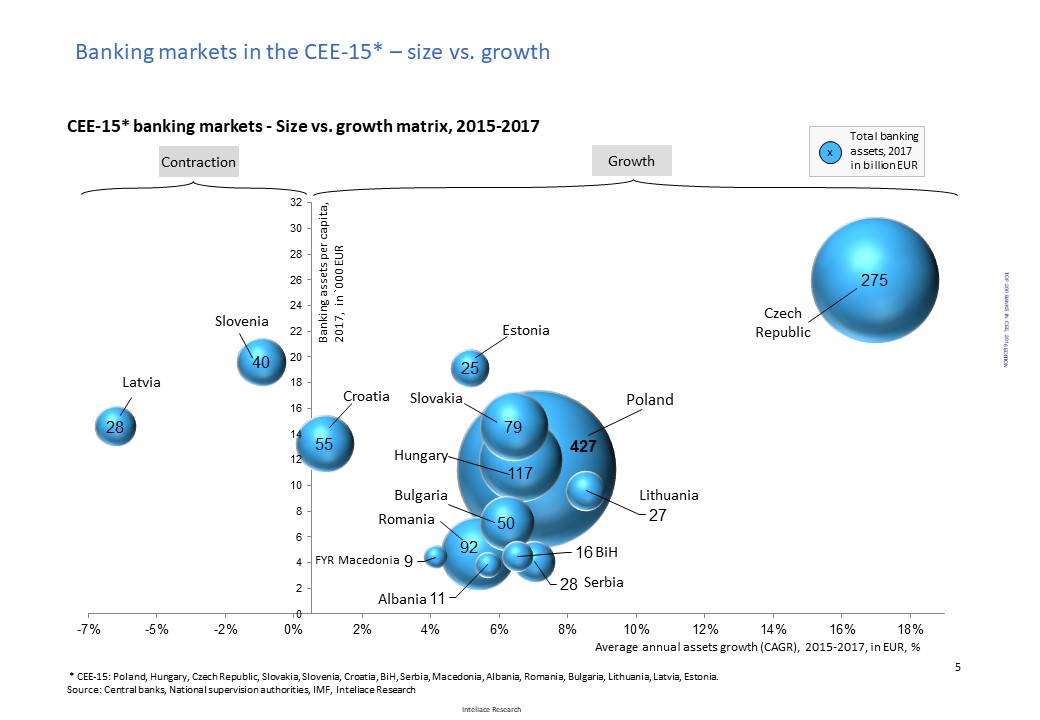
Total banking assets in CEE15* jumped to EUR 1.28 trillion in December 2017, after adding over 10% within last year. Czech Republic and Poland were the most rapidly growing markets. Growing assets were boosted by the nominal asset increases and appreciating currencies. By contrast to growing assets, the profitability of major CEE banks declined slightly with weighted ROA and ROE contracting to 1.13% and 9.8% respectively. The leading banking groups in the region: Erste, KBC and UniCredit did not change, however, the consolidation processes continued with local players getting stronger and smaller foreign players seeking to exit. ------------------------------------------------------------------ *CEE15 include: Poland, Czech Republic, Hungary, Slovak Republic, Romania, Bulgaria, Estonia, Latvia, Lithuania, Croatia, Slovenia, Serbia, Bosnia and Herzegovina, Albania, and FYR Macedonia.
Insurance market in Poland, 2018-2020
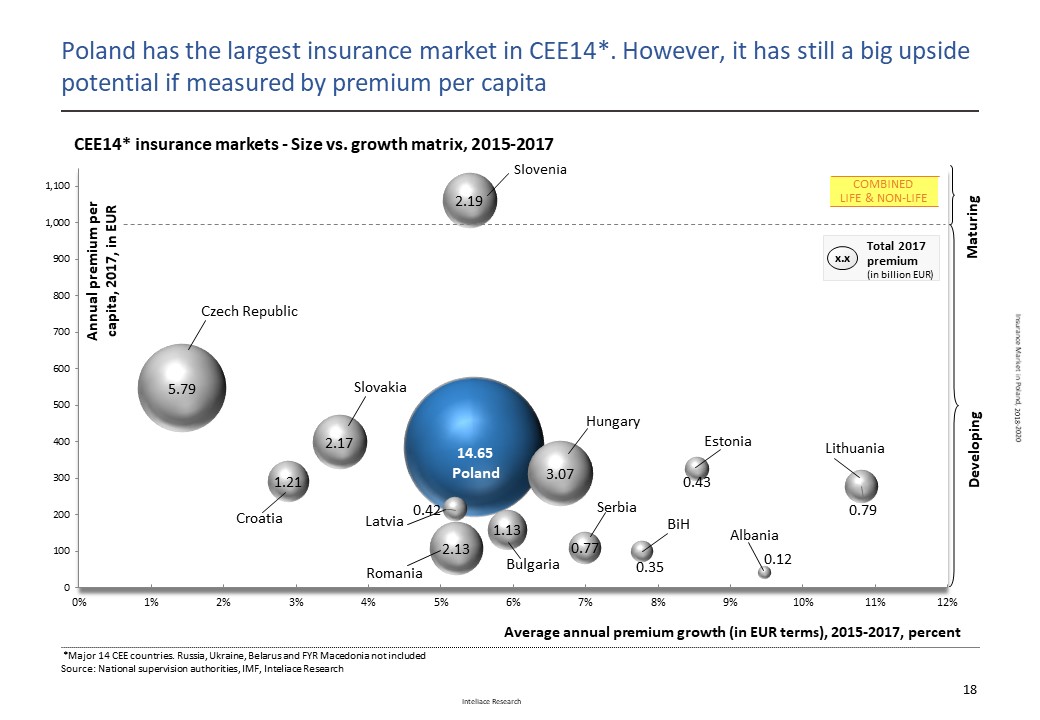
Poland has the largest insurance sector within the CEE with nearly € 15 billion in premium written p.a. and over 41% regional share in terms of GWP. 2017 was a good year for insurers operating in Poland. Premium written in non-life insurance surged by 18% YoY to nearly PLN 37.8 billion fuelled primarily by car insurance and benefiting from both higher tariffs and increasing number of insured cars. Also financial risks, health-related and property insurance sustained fast growth. By contrast, a remarkable reversal took place in the life insurance segment. After multiple years of declines, life insurance premium rebounded and started to grow again. This was possible thanks to much higher sales of unit-linked insurance – a result of multiple factors, including stronger equity markets and low interest rates at banks. Overall life insurance premium advanced by 3 %YoY and reached PLN 24.6 billion in 2017. For more information on recent developments in the Polish insurance sector, please refer to the full publication.
Bank outlets in Poland, 2018
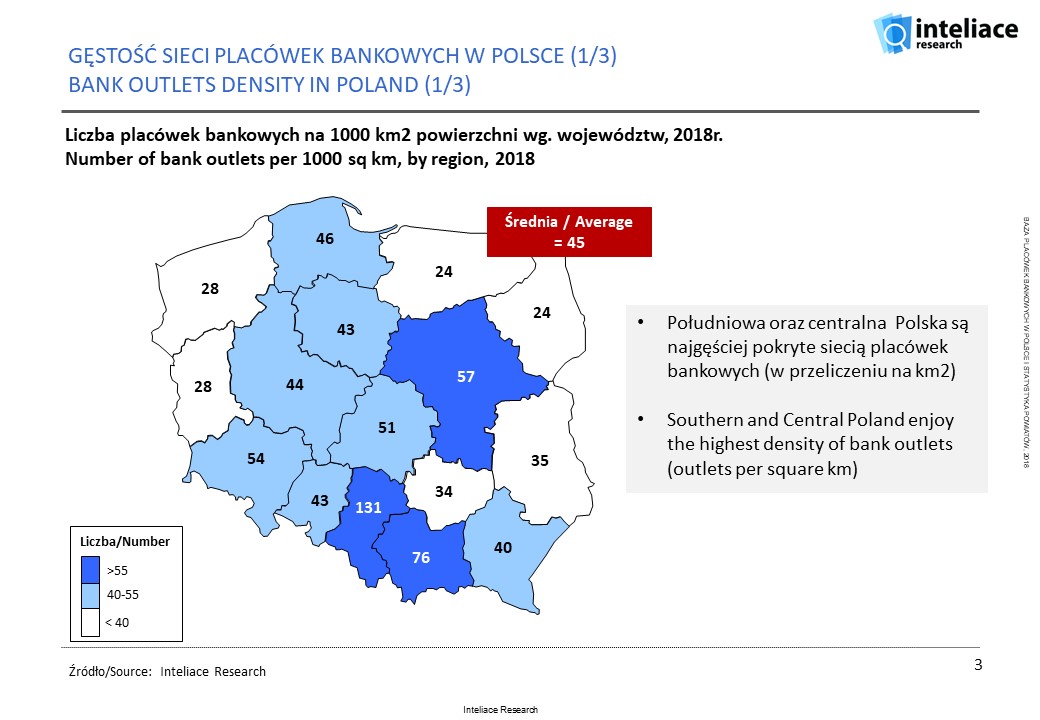
The number of bank outlets in Poland continues to fall. As of Q1 2018, there were 14158 bank and credit union outlets, which corresponds to 368 outlets per million capita. The total number of outlets fell in Q1 2018 vs. Q1 2017 by 917 outlets or by over 6% YoY. Looking forward, further bank outlet closures should be expected. An increasing use of remote channels, including mobile, and a growing personal service cost will put pressure on banks to close even more outlets. For more information please refer to the full publication/database.
Banking Market in Poland, 2018-2020
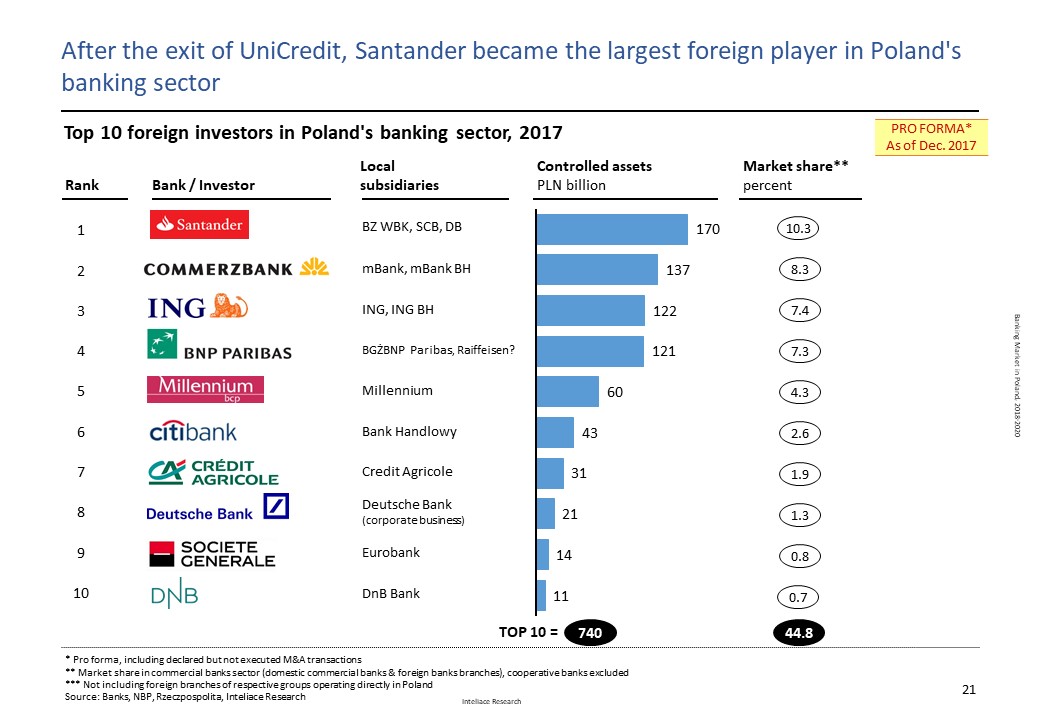
Banking volumes have continued to grow during 2017, however, they increased slower than in the past. Deposits of non-financial clients at banks reached PLN 1.14 trillion after a 4% YoY growth while client loans increased to PLN 1.15 trillion, recording a 3% YoY growth. The recent change in key volumes was balanced across all client segments, however, corporate lending advanced slightly faster than other variables. As a consequence of growing client volumes, total banking assets went also up and reached PLN 1.78 trillion as of December 2017. Consolidation trends observed in previous years continued also in 2017. Santander`s subsidiary - BZ WBK secured the acquisition of retail and SME activities of Deutsche Bank Polska while BGŻ BNP Paribas was the winner in negotiations for the business of Austria's Raiffeisen bank leaving Poland. As a consequence of recently announced deals, the banking market will soon become pretty concentrated with 6 major banks managing assets in excess of PLN 100 billion each and holding a combined market share in excess of 55%. For more information on recent developments in the Polish banking sector, please refer to the full publication.
Mortgage lending in Poland, 2018-2020
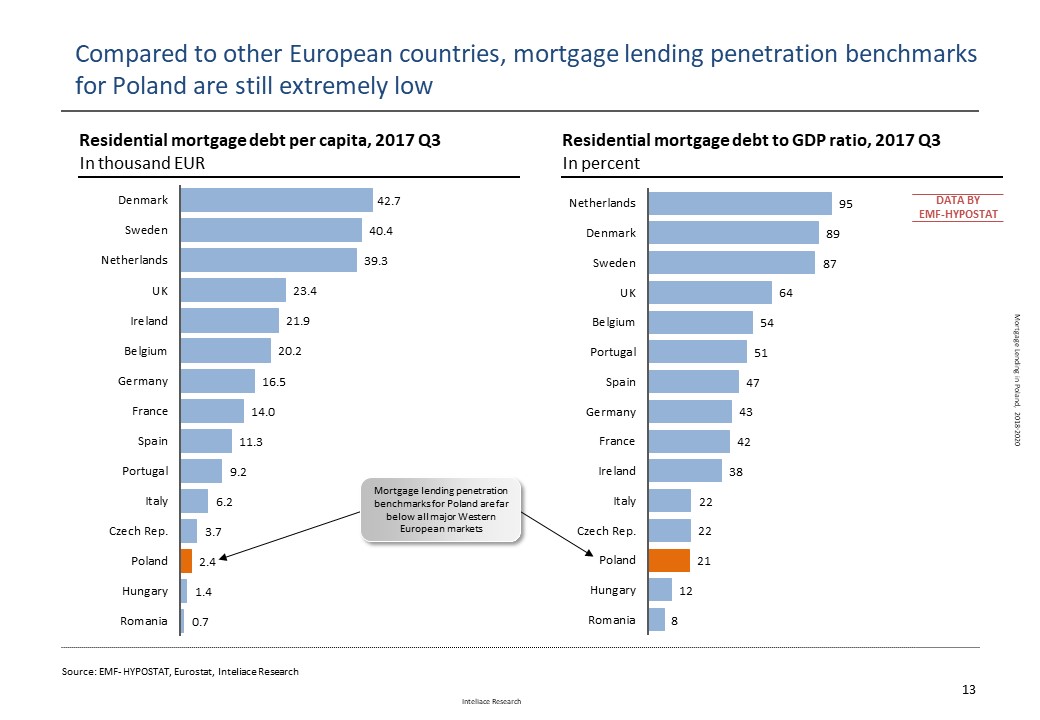
Residential construction in Poland accelerated again in 2017 extending growth trends observed since 2014. While the number of completions jumped by 9%, the number of new permits surged by nearly 18% in 2017 alone. The key driving forces of new residential construction remained unchanged. Stable, record-low interest rates and rising purchasing power of individuals fuel new purchases. Moreover, real estate investments have been increasingly popular in view of growing residential rents and due to low opportunity cost of holding cash or deposits. After multiple years of stagnation mortgage lending has seen some recovery during 2017. Sales of new mortgage loans increased by 5% and 11% in terms of volume and value respectively, which also reflected growing average loan ticket size. Looking forward, in our base scenario, we expect new mortgage lending to keep growing at moderate rates through 2020. The total outstanding is likely to increase by 5% p.a. For more information on recent developments in the Polish banking sector, please refer to the full publication.